Contents
- Abstract
- Why modems still matter
- IMS and SIP, in plain terms
- How memory bugs become compromises
- The target
- Acquiring the image
- Locating the parser
- The descriptor table
- Anatomy of the decoder
- The defect
- Reachability
- The session gate
- Reproduction
- Results
- Exploitability
- Impact, honestly
- Remediation
- References
This article is an independent reproduction and analysis of CVE-2023-24033. The vulnerability was discovered and reported by others well before this work, and is documented in the March 2023 Android Security Bulletin. Nothing here is a new finding, and no new vulnerability is disclosed.
Credit for the discovery belongs entirely to its original reporters. The author claims none of it. The contribution here is narrower: locating the defect in one specific shipped image, reconstructing the path that reaches it, and reproducing it under emulation so the explanation can be checked rather than taken on trust.
Addresses are hexadecimal, so 0x78 is decimal 120 and
0x42bfc0e4 is an offset inside the modem image. A register is a
small named storage cell inside the processor; ARM32 has sixteen, and the first four carry
a function's arguments. A breakpoint marks an address where the emulated CPU
stops so we can read those registers and the surrounding memory.
None of that is needed to follow the argument. If you read only two sections, read the defect and the impact. The rest is the road between them.
Terms used in this article
- Attribute
- An
a=line in SDP carrying a parameter. This article follows one whose value is a space-separated list. - Baseband / modem
- The processor and firmware that run the cellular stack, separate from Android and the apps.
- Block
- A region of memory returned by
malloc. Nothing inside it records where it ends. - Decoder
- The function that parses one attribute's value.
- Descriptor table
- A firmware array mapping attribute names to decoder functions.
- Dispatcher
- The code that looks up a descriptor and calls its decoder.
- Entry
- One space-separated item inside an attribute value. One entry becomes one slot.
- Heap
- The memory pool that
mallochands blocks out of. - IMS
- IP Multimedia Subsystem, the operator network that carries voice and video over IP.
- Out-of-bounds write
- A store past the end of the object the code meant to write to.
- Primitive
- A repeatable capability an exploit needs, such as writing to an address of the attacker's choosing.
- Slot
- One 12-byte cell in the array: a present flag, a pointer to the copy of the entry, and a length.
Abstract
CVE-2023-24033 is a memory corruption defect in the Session Description Protocol parser shipped in Samsung's Shannon baseband. The parser splits an SDP attribute value on spaces and stores each entry in a fixed array of ten twelve-byte slots, but the entry loop performs no bound check. A value containing eleven entries writes a slot entry past the end of a 120-byte heap allocation.
We recovered the affected firmware from a Pixel 6, identified the vulnerable decoder through the attribute descriptor table, and reconstructed the dispatch chain linking the IMS entry point to that decoder. The firmware was then executed under a full-system emulator, the affected session registered in the modem's own lookup structures, and the parse driven from the real entry function. The overflow was observed directly in heap memory.
This article documents the method and the evidence, and is explicit about the boundary: the work establishes corruption of allocator-adjacent memory. It does not establish control-flow hijack.
- Identifier
- CVE-2023-24033
- Component
- IMSPL SDP parser, Shannon baseband
- Class
- Heap buffer overflow, off-by-one slot
- Vector
- IMS signalling, network adjacent
- Affected silicon
- Exynos Modem 5123 / 5300 and related
- Fixed
- Android bulletin 2023-03-01
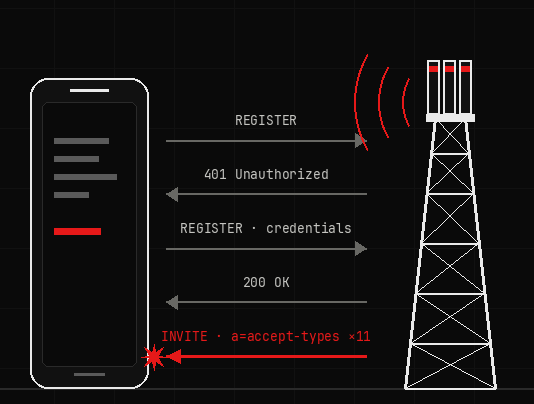
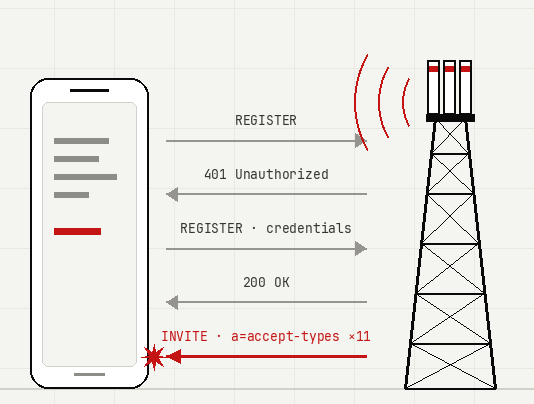
accept-types attribute with eleven entries. The application processor is not
involved at any point: the message is decoded by the baseband and handed straight to the
attribute decoder, which writes twelve bytes past its own allocation.
01Why modems still matter
A modern handset contains two independent computers. The application processor runs the operating system you interact with, with its sandboxing, permission prompts and verified boot. The baseband is a separate system-on-chip with its own processor, its own memory and its own real-time operating system. It owns the radio, terminates the cellular protocols, and on current devices also hosts the IMS stack that carries voice and messaging over IP.
Code executing in the baseband sits outside the application processor's isolation boundary. No app permission applies to it, no sandbox covers it, and the device's userspace cannot audit it. It also processes attacker-supplied bytes by design, because parsing network messages is what it is for.
The baseband firmware stack is layered. Radio symbols are decoded at the bottom; frame, radio-resource and mobility protocols sit above; IP carries signalling; and at the top, IMS runs SIP with SDP inside it. Each layer strips its own framing and passes the remainder upward. Reaching the IMS parser therefore requires the message to traverse every lower layer successfully, which constrains the realistic attacker model to someone positioned on the signalling path.
02IMS and SIP, in plain terms
Everything in this article passes through two things with unhelpful names. SIP carries the messages. IMS is the operator network built to route them. If you have made a call on a phone released in the last decade, both were involved, whether or not the call touched the old circuit-switched network.
SIP is signalling, and it looks like HTTP
SIP is a text protocol. A request has a method, a URI, headers, a blank line, and an
optional body. The methods that matter for a call are INVITE to start a
session, ACK to confirm the final response, BYE to end it, and
REGISTER to tell the network where you are. Replies are three-digit codes:
180 means the phone is ringing, 200 means yes.
No audio travels in SIP. A session is negotiated first. The caller sends an
INVITE whose body describes what it can receive, the callee answers with its
own description, and both sides then open a separate stream in a format they agreed on.
That body is SDP, the Session Description Protocol, and it is where this article's defect
lives.
IMS is the network that carries it
IMS, the IP Multimedia Subsystem, is the operator-side architecture that makes SIP work at telephone scale. It is neither a protocol nor a single server. The phone registers once with a serving node, and from then on its requests are routed through a small set of call-session control functions to an application server implementing whichever service is in use: telephony, messaging, or chat.
What this looks like on an ordinary day
A VoLTE call is SIP with an SDP body, and it is the default on most networks now. Wi-Fi
calling is the same stack over a different access network. SMS over IMS replaces the old
signalling-channel text message with a SIP MESSAGE. RCS uses the same
registration and adds chat and file transfer. All of it sits in the baseband rather than
in Android because the operator needs the phone reachable and authenticated even when the
application processor is asleep.
Why an SDP parser has a list in it at all
Codecs are negotiated by name, and the names live in a= lines. The
accept-types attribute is a space-separated list of media types the sender is
willing to accept. In normal traffic it is short, because a phone supports a handful of
codecs. Nothing in the protocol says how long the list may be, and the receiver allocates
for the number it expects before reading whatever arrives.
That sentence is the vulnerability in miniature. The next section is the general shape of it; the rest of the article is this particular instance.
03How memory bugs become compromises
Before the firmware, the mechanism. Almost every serious memory vulnerability follows the same four-step path, and most of them never get past the second step.
- The bug. A write lands at an address the program did not intend to touch. So far, nothing has happened beyond that write.
- Corruption. The bytes at that address belonged to something else: a neighbouring object, a length, a pointer, or the allocator's own bookkeeping.
- A primitive. The corruption is arranged so it can be repeated usefully, ideally becoming a read or write at an address the attacker chooses.
- Control. The primitive overwrites a function pointer, a return address or a dispatch entry, and execution goes where the attacker wants.
Most of the work sits between step two and step four. It is also why a heap-overflow headline and a working exploit can be months apart.
The processor does not know what an array is
A processor has registers and an address space. It does not know that ten twelve-byte structures live at some address and that an eleventh is illegal. It knows one instruction: store these bytes at this address. Every bound in a program is there because a person wrote a check.
malloc returns a pointer to a block and records how large it is. Nothing inside
the block knows where it ends. So when a loop writes to base + index * 12
without comparing index against ten, the eleventh write is not an error the
machine can detect. It is an ordinary store into memory that belongs to something else.
The allocator is a locker room
A heap allocator hands out blocks and keeps a ledger so it can take them back later. That
ledger lives in the same writable memory as everything else. Free space between blocks is
often filled with a known pattern so failures are easier to diagnose; in this firmware the byte is 0xAA.
That is why overflowing into the ledger matters. If the record of what is allocated and what is free can be altered, the allocator's next decision is compromised, and the allocator is a trusted internal component. A corrupted ledger can make the following allocation return an address the attacker chose.
Three shapes of the same class
| Shape | What fails | Attacker controls |
|---|---|---|
| Unbounded copy | a strcpy-style copy into a fixed buffer | the length |
| Undersized allocation | integer arithmetic yields a smaller size than the copy | the arithmetic |
| Missing bound on a fixed array | the capacity exists, but one loop never checks it | the count |
This defect is the third shape: an out-of-bounds write (CWE-787) on the heap (CWE-122). That shape is the one that survives review, because the allocation is right, the arithmetic is right, and a bound check really does exist in the function — in a different loop. A reviewer finds the check and stops looking.
04The target
The original intent was a Pixel 7, whose Exynos 5300 modem was disassembled and fitted with a single-function harness. Full-system emulation was the requirement, and the public emulator does not model that part: its memory map is not a static table in the image, and the enable path points the MMU at an address no loadable section covers. Pacing that work honestly put it at weeks with a real chance of stalling.
The Pixel 6 carries the Exynos 5123, which is modelled, and which runs the same vendor IMS codebase with the same parser and the same defect. It is the target used for everything that follows.
| Attribute | Value |
|---|---|
| Device | Google Pixel 6 (oriole) |
| SoC | Google Tensor GS101 |
| Modem | Samsung Exynos Modem 5123 (Shannon) |
| Core | Cortex-A, ARM32, Thumb, MMU |
| Firmware build | g5123b-90933-210902-B-7697269 |
| Image size | 108,755,648 bytes (TOC container) |
| Code section | MAIN at 0x40010000 |
| Decoder | IMSPL_SdpParser_DecodeAtrb_AcceptTypes @ 0x42765ee4 |
05Acquiring the image
Modem firmware is not distributed as a modem binary. It is nested inside the factory image: an archive containing a partition image in a vendor container, which holds a filesystem, which holds a compressed copy of the modem container. Each layer is a distinct format and each has to be parsed correctly before the next becomes visible.
The inner container begins with the ASCII magic TOC and is followed by a
table of sections with their file offsets, load addresses and sizes. That table is the
only reason any of the later address arithmetic is possible.
00000000  54 4f 43 00 00 00 00 00 00 00 00 00 00 00 00   TOC.............
00000010  00 00 00 00 20 03 00 00 00 00 00 00 07 00 00 00   .... ...........
00000020  42 4f 4f 54 00 00 00 00 00 00 00 00 20 03 00 00   BOOT........ ...
00000030  00 00 00 00 b0 fe 00 00 48 3b 63 19 01 00 00 00   ........H;c.....
Resolving the table yields the layout below. The translation between a file offset and an address is linear within a section, and it is worth writing down once: every subsequent address in this article is an address, not an offset.
| Section | File offset | Load address | Size |
|---|---|---|---|
| BOOT | 0x00000320 | 0x00000000 | 0x0000feb0 |
| MAIN | 0x000101e0 | 0x40010000 | 0x06321c80 |
| VSS | 0x06331e60 | 0x4f900000 | 0x0047e620 |
| APM | 0x067b0480 | 0x00010000 | 0x00007620 |
For MAIN the mapping is addr = 0x40010000 + (offset - 0x101e0).
06Locating the parser
Nobody reads 108 MB of machine code linearly. The productive approach is to start from
a string and move outward, because vendor builds habitually retain source paths and log
format strings. Searching the image for the ASCII sequence accept-types
returns a single hit, and it lands inside a data structure rather than inside a message
string. That is the luck: a message string would have told us nothing.
$ grep -abo "accept-types" modem.bin
1290876:accept-types          # offset 0x13b27c -> address 0x4013b09c

$ grep -abo "SDPPARSER" modem.bin
14512995:SDPPARSER/Code/src/IMSPL_SdpParser_Attributes.c
14514274:SDPPARSER/Code/src/IMSPL_SdpParser_Entry.c
14514368:SDPPARSER/Code/src/IMSPL_SdpParser_Utility.c
Those source paths name the subsystem, IMSPL SdpParser, and they appear
because the code passes them to its own logging macros. That gives a reliable runtime
signal: when the firmware later prints
IMSPL_SdpParser_Attributes.c, we are inside the code we set out to find,
without having to infer it.
Strings identify subsystems. Tables identify handlers. Function pointers inside those tables identify the code. Each step yields a concrete address that can be verified independently, which is what keeps the chain from drifting into guesswork.
07The descriptor table
The SDP parser is generic: it does not know what any particular attribute means. It carries a table with one row per attribute, and each row names the function responsible for that attribute. This is a dispatch table, and it is the standard way protocol implementations avoid a thousand-way branch.
Each row is 44 bytes. The first sixteen hold the attribute name inline, followed by a length, a small integer the code calls a class, and three function pointers: decode, encode, and free. Decode is the one that consumes network input.
0x42765ee4.
Index 32 is accept-types, with class 0x0c and decode
0x42765ee5. Clearing the Thumb bit gives the function we need to read:
IMSPL_SdpParser_DecodeAtrb_AcceptTypes at 0x42765ee4.
08Anatomy of the decoder
The decoder takes a value string, its length, and an output slot. Its first substantive
act is a heap allocation of 0x78 bytes, which is 120. That number is not arbitrary:
the routine intends to hold at most ten entries, and each entry occupies twelve bytes.
Each slot is three fields: a one-byte present flag, a four-byte pointer to a copy of the entry, and a four-byte length. The entry text itself is allocated separately, which is why a three-entry value produces four allocations rather than one.
The routine then splits the value on the space character and, for each piece, writes one slot. Because the block is only 120 bytes, ten entries consume the allocation exactly.
09The defect
The loop increments a slot index after every entry and stores at
record + index × 12. There is no comparison between the index and ten
anywhere on that path. The only branch at the bottom of the loop tests the result of the
delimiter scan, so the loop terminates when the text is exhausted — not when the array
is full.
A value containing eleven entries therefore performs an eleventh write: slot index 10, at
record + 0x78, the first byte past the allocation. Twelve bytes of
attacker-influenced data land outside the block the function owns.
The code allocated for ten; that much is not in doubt. The failure is that the limit exists as an allocation size and as a later loop bound, but not as a check in the loop that actually writes.
A bounds check does exist in this function. It appears in a subsequent cleanup loop
that walks the array to mark unused slots, and it reads cmp #9. A
reviewer scanning for the guard finds one, concludes the function is defended, and
moves on. The guard is real; it is in the wrong loop. Checks have to be evaluated by
position, not by presence.
10Reachability
Demonstrating that a function is broken is not the same as demonstrating that input reaches it. The path from an SDP line to this decoder runs through six layers, each with a defined responsibility.
This is confirmed at runtime by the firmware's own logging. During the reproduction the
modem printed IMSPL_SdpParser_Attribute_Decoder, then
findAtrbType 32, then DecodeAtrb_AcceptTypes. That is not our
interpretation of the call graph; it is the vendor code reporting its own dispatch.
11The session gate
The IMS entry point does not parse SDP unconditionally. It first resolves the message's session identifier to an application identifier, and that application identifier to a context. Both lookups read global tables. If either fails, the function logs an error and returns without parsing.
Entering with an unregistered session produced exactly that refusal (NO Matching APPID Found, ContextId not found, Invalid ContextId Found), which was itself useful, because it confirmed the
call was landing in the real entry point rather than a copy.
12Reproduction
Static reading establishes what the code can do; execution establishes what it does. The firmware was run under FirmWire, a full-system emulator for baseband images. Upstream supports Cortex-R parts only, so a fork adding Cortex-A support, MMU parsing and the peripheral set for this SoC was used. The firmware image itself is unmodified.
The intended invocation path — inject a task into the firmware's own scheduler and have it run — was built and does not work on this image: the task appears in the task list but accumulates zero executed basic blocks in coverage. The working approach is the technique a debugger's call command uses. Stop the CPU at a frequently executed function, write the payload and supporting structures into writable memory, set the argument registers, point the program counter at the target, and set the link register to a known return address so execution can be recovered afterwards.
; stop at pal_RegItemWrite (0x42bfc0e4), then:
r0  = argument        ; descriptor or value pointer
r1  = length
r2  = out pointer     ; third argument where required
lr  = 0x40020acd      ; BXLR — return lands on a known instruction
pc  = target          ; real firmware function
cpsr.T = 1              ; Thumb state
The harness exposes five entry points, each proving one more link in the chain. The last one enters at the genuine IMS function with a session registered in the modem's own tables.
| Mode | Entry | What it establishes |
|---|---|---|
| attr | 0x42765ee4 | the decoder alone overflows |
| body | 0x42d04e6c | real SDP text is parsed and dispatched |
| sip | 0x428690fc | real IMS entry; rejects an unregistered session |
| sip2 | 0x4286915a | parser path overflows once past the gate |
| sip3 | 0x428690fc | real entry with a valid session produces the overflow |
What follows is the decode replaying. The console lines are the firmware's own, captured from a recorded run and replayed in order; the slot panel beside them is driven by the same event sequence. Watch the count.
The modem does not fault. We tested up to forty entries - a 480-byte write beginning inside a 120-byte allocation - and the firmware continued running, because the overflow lands in mapped heap space rather than unmapped memory. Nothing about the corruption announces itself. That is precisely what makes this class of defect dangerous: it must be detected by inspection, not by watching for a crash.
13Results
After the parse, the array begins at 0x50518a20. Nine in-bounds slots hold
a present flag, a pointer to the entry copy and a length of three. Slot 10 begins exactly at
record + 0x78.
50518a10  00 00 00 00 00 01 00 00 10 00 00 00 aa aa aa aa
50518a20  01 00 00 00 20 82 51 50 03 00 00 00 01 00 00 00   slot 0
50518a30  60 82 51 50 03 00 00 00 01 00 00 00 a0 82 51 50
50518a40  03 00 00 00 01 00 00 00 e0 82 51 50 03 00 00 00
50518a50  01 00 00 00 20 83 51 50 03 00 00 00 01 00 00 00
50518a60  60 83 51 50 03 00 00 00 01 00 00 00 a0 83 51 50
50518a70  03 00 00 00 01 00 00 00 e0 83 51 50 03 00 00 00
50518a80  01 00 00 00 20 84 51 50 03 00 00 00 01 00 00 00
50518a90  60 84 51 50 03 00 00 00 01 aa aa aa a0 84 51 50 03 aa aa aa
50518aa0 03 aa aa aa aa aa aa aa| Slot | Address | Present | Pointer | Length |
|---|---|---|---|---|
| 0 | 0x50518a20 | 01 | 0x50518220 | 03 |
| 8 | 0x50518a80 | 01 | 0x50518420 | 03 |
| 9 | 0x50518a8c | 01 | 0x50518460 | 03 |
| 10 | 0x50518a98 | 01 | 0x505184a0 | 03 |
The aa bytes surrounding the slot-10 entry are the allocator's free-space
fill, untouched until this write. Their presence inside the written entry — between the
present flag and the pointer, and after the length — is direct evidence that the write
entered memory the allocation never owned. The array address is stable across runs.
We did not reverse the allocator's chunk header. Sixteen bytes precede the block and the free-space fill follows it, but what those bytes encode is not established here. The finding does not depend on that knowledge — the write leaves the block the function owns — so mapping the header is left open rather than guessed at.
14Exploitability: from corruption to control
The write is proven. What follows is what an attacker would need to do with it, and why none of it was attempted here.
What the primitive actually is
Three stores per entry: a byte 01 for the present flag, a word pointing at the
copy of the entry, and a word holding its length. The write starts at a fixed offset from
the block and repeats every twelve bytes for as many entries as the message carries.
So the attacker controls what is written and how far it runs, but not where it starts, and not what sits beside it. That last part is the real constraint: the target of the corruption is chosen by the allocator, not by the attacker.
Three ways an overflow like this becomes control
The ledger route has a classic form: a free-list unlink, where the allocator follows a corrupted next-pointer and performs the attacker's write while it thinks it is tidying up. Bending a neighbour is cheaper because it needs no allocator knowledge, but it depends on what the allocator happened to place after the array. Overlap is the strongest of the three, because two pointers into one block turn a narrow write into a second, independent handle on the same memory.
Why grooming comes first
None of those routes works by chance. The attacker needs a chosen object sitting immediately after the array, which means shaping the heap before the message arrives: allocating known sizes, freeing some, and letting the allocator's placement rules line the pieces up. That discipline is called heap grooming, and it is why heap bugs are described as probabilistic rather than deterministic.
What this firmware does, and does not, do about it
Stack canaries are present. Nearly every function we read loads a value from
DAT_4458afcc on entry and compares it before returning, which defends stack
overflows and does nothing here. Heap hardening we could not establish: no heap cookies or
integrity checks on the allocation path, though we did not test for them exhaustively. The
heap address was identical across emulation runs, which says nothing about a real device
whose bootloader may or may not randomise.
Everything above is mechanism, not result. A working chain needs the allocator's header layout, a grooming strategy that survives the parser's own allocations, a target object worth corrupting, and a way to survive the frees that follow. We have none of those and the article does not claim them. What is established is narrower and still serious: a legal network message causes a write outside a heap allocation inside the modem.
15Impact, honestly
The primitive is a write of one twelve-byte slot entry, starting at a fixed offset just past a 120-byte allocation, with partial control over three of those bytes: the pointer field can be made to reference an attacker-supplied copy of an entry, and the length field derives from that entry's length. It repeats once per additional entry, so the reach scales with the input. At forty entries the write extends roughly 360 bytes past the block. That is meaningfully more than a single-byte overwrite, but it does not by itself give control of execution.
Turning it into control requires influence over heap layout: placing a chosen object immediately after the array so that the overflow lands on something whose corruption is useful, then surviving the allocations and frees that follow. That is a separate body of work with its own failure modes, and it is not attempted here.
The real, unmodified firmware boots under emulation; the real IMS entry point accepts a registered session; the real SDP parser dispatches to the real decoder; and that decoder writes past its own allocation. The reproduction is deterministic.
No live SIP message traversed the network stack. The descriptor and SDP body are constructed in memory. No heap grooming was performed. No control-flow hijack was attempted. The target is the Exynos 5123, not the 5300. The session registration is experiment scaffolding and is not a firmware modification.
16Remediation
The defect was addressed by Samsung and distributed through the Android security bulletin dated 2023-03-01. Devices at or above that patch level are not affected; the build examined here predates it.
Three changes would each have prevented this, and none of them is exotic. Enforce the slot limit in the loop that writes, and derive both the allocation size and that bound from one constant. Reject the whole attribute when the entry count exceeds the maximum instead of truncating silently. Treat any count that appears in both an allocation and a loop as something to check at every write site, since the check in the cleanup loop is what made this look safe.
17References
- Android Security Bulletin, March 2023. The public record for CVE-2023-24033. source.android.com/docs/security/bulletin/2023-03-01
- NVD entry for CVE-2023-24033, including the CNA description and both CVSS scores. nvd.nist.gov/vuln/detail/CVE-2023-24033
- Hernandez, Muench, Maier, Milburn, Park, Scharnowski, Tucker, Traynor and Butler. FirmWire: Transparent Dynamic Analysis for Cellular Baseband Firmware. NDSS 2022. github.com/FirmWire/FirmWire
- The Cortex-A fork of FirmWire used for this work, on the
lorisbranch. github.com/SyNSec-den/FirmWire - ShannonLoader, a Ghidra extension that parses the Shannon TOC container. github.com/grant-h/ShannonLoader
- ShannonFirmware, the public image collection the g5123b image came from. github.com/grant-h/ShannonFirmware
- RFC 4566, SDP: Session Description Protocol. rfc-editor.org/rfc/rfc4566
- RFC 4975, The Message Session Relay Protocol, which defines the
accept-typesattribute. rfc-editor.org/rfc/rfc4975 - 3GPP TS 24.229, IP multimedia call control protocol based on SIP and SDP. 3gpp.org/ftp/Specs/archive/24_series/24.229
- CWE-787: Out-of-bounds Write. cwe.mitre.org/data/definitions/787.html
- CWE-122: Heap-based Buffer Overflow. cwe.mitre.org/data/definitions/122.html
NVD and the CNA disagree on scope, and a reader will notice. NVD scores CVE-2023-24033 at 9.8 with confidentiality, integrity and availability all high, while the CNA description says the flaw can lead to denial of service and scores it 7.5 with availability only. This article takes no position between them: it establishes the write, and states plainly that it did not establish control of execution. The CWE labels used earlier are a technical description of the defect observed here; NVD records no specific CWE for the CVE, and CISA lists CWE-20.
Appendix: addresses used
| Symbol | Address | Role |
|---|---|---|
| accept-types (descriptor) | 0x4013b09c | table row, index 32 |
| descriptor table base | 0x4013ab1c | stride 0x2c |
| name → index | 0x4277183c | scans up to 0x30 entries |
| attribute dispatcher | 0x4276558a | splits on colon, calls decode |
| DecodeAtrb_AcceptTypes | 0x42765ee4 | the overflow |
| SDP body parser | 0x42d04e6c | line walker |
| IMSSH_SC_ProcessSdpReq_RCS | 0x428690fc | IMS entry point |
| session table | 0x487a3000 | sessid → object |
| context list head | 0x487a37d4 | appid → ctxid |
g5123b-90933-210902-B-7697269. The firmware was not modified. Experiment
logic — payload construction, structure placement, and the register-level invocation —
lives entirely in an external driver script.